The Martyrdom of the Ledger
Nadia Lodroman | Oracle EPM Consultant | Integrity in Every Insight.
Listen to Tresora and Ledgeron's chatting about this blog post:
Why Accountants Save Pennies While Burning Their Sanity
It’s the great accounting paradox. We are the masters of efficiency, the guardians of the bottom line, and the architects of fiscal responsibility. We can spot a $15 variance in a multi-million dollar reconciliation from three miles away.
But when it comes to our own lives? We are surprisingly bad at math.
As an industry, we’ve fallen into a dangerous trap: We value the company’s dollar more than our own time, health, and sanity. Here is why we do it—and why it’s a calculation that no longer adds up.
1. The "Cost Center" Complex
For decades, accounting has been labeled a "cost center." Unlike sales or product development, we aren't seen as "revenue generators." This label creates a psychological burden. We feel that to justify our existence, we must be the ultimate examples of frugality.
The Result: We’d rather spend 10 hours manually mapping a messy trial balance than "waste" money on an automated tool that could do it in ten seconds. We treat our manual labor as "free," when in reality, it is the most expensive resource the company has.
2. The Badge of Honor in the Burnout
There is a toxic romanticism in the "Audit Grind." If you aren't staying until 9:00 PM during busy season, are you even a real accountant? We’ve turned suffering into a metric of commitment.
When a tool promises to "ease the burnout," some part of our traditionalist brain whispers that we’re "taking the easy way out." We’ve mistaken friction for discipline.
3. The Risk of the "New" vs. The Safety of the "Slow"
In our world, compliance is king. We know the Excel formulas we built in 2014 work. They are clunky, they break, and they require a blood sacrifice every month-end, but they are known.
We choose the "safe" path of manual exhaustion over the "perceived risk" of modern efficiency, forgetting that human error due to fatigue is the greatest compliance risk of all.
The Real Audit: What is your time actually worth?
I speak from experience. I am a recovering accountant who spent years in the trenches of month-end closes and audit cycles. I’ve seen teams agonize over the cost of a subscription while losing thousands of dollars in billable hours to manual data entry.
Here is the truth that many are afraid to say: It doesn’t matter if you are a small business on QuickBooks or Sage, a mid-market firm on Visma, or a global giant on Oracle EPM.
The cost of the software—any software—is consistently lower than the cost of a burned-out accounting team. When you factor in the price of team turnover (replacing a senior is 1.5x their salary), the risk of manual errors, and the sheer mental toll of "spreadsheet hell," the "expensive" tool is actually the most conservative financial choice you can make.
Let’s look at the ROI of sanity. If a tool costs the company $10,000 a year but saves your team 500 hours of manual data entry, the math is simple:
| Metric | Manual Process | Automated Tool |
|---|---|---|
| Hourly Cost (Average) | $75/hr | Included in Subscription |
| Total Labor Cost | $37,500 | ~$10,000 |
| Risk of Error | High (Fatigue-driven) | Low (Systematic) |
| Team Retention | "I'm quitting in May" | "I can actually go to the gym" |
It’s Time to Reconcile Our Priorities
We need to stop treating our sanity as an off-balance-sheet item. Saving the company money is part of the job, but protecting the integrity of the financial function—and the people who run it—is the whole job.
A burnt-out accountant is a liability. A frustrated auditor is a flight risk. If we are truly the financial experts we claim to be, we need to start acting like it by investing in the one asset that actually matters: our capacity to do high-level work without losing our minds.
Stop counting the pennies on the software invoice and start counting the hours you’ll never get back.
Is your team currently choosing "manual" over "sanity"?I’ve made it my mission to help finance teams bridge this gap. Whether you are looking for the right entry-level tools or you’ve scaled to the point where you need an Oracle EPM specialist to streamline your complexity, I can help. I advise on the right tools, implement them to fit real-world accounting workflows, and ensure you achieve a true ROI on your time.
Let's get your sanity back—reach me at www.lodroman.com and let's talk about a better way to work.
Turning financial complexity into operational clarity. Because in Finance, Integrity is Permanent.
General EPM Strategy FAQs
Why should a company use EPM Automate instead of custom scripting
EPM Automate allows for robust, bi-directional data orchestration between Oracle EPM and source ERPs (like NetSuite or Fusion) using native capabilities. It is highly scalable, easier to maintain during Oracle's monthly updates, and avoids the fragility of heavy custom coding.
Can Oracle Cloud EPM integrate with multiple different ERPs simultaneously?
Yes. Through strategic data pipeline architecture, Oracle EPM can ingest, consolidate, and even write-back finalized data to multiple disparate ERPs concurrently, acting as the single source of truth for the enterprise.
How does Oracle FCCS handle Minority Interest (NCI) and CTA?
While standard FCCS provides out-of-the-box functionality, complex global enterprises often require advanced configuration to isolate and calculate Minority Interest (NCI) and Cumulative Translation Adjustments (CTA) accurately at the top consolidated hierarchy without relying on manual journals.
Can you bypass the out-of-the-box Goodwill calculation in Oracle FCCS?
Yes. By utilizing advanced native configuration and custom consolidation rules, you can bypass standard Goodwill Input/Offset functionality to meet highly specific, non-standard acquisition accounting requirements.
How many daily transactions can Oracle ARCS process?
Oracle ARCS is built for enterprise scale. With proper architecture in the Transaction Matching engine, ARCS can easily process and auto-match hundreds of thousands of daily banking transactions, representing billions of dollars in value.
What is the difference between Transaction Matching and Reconciliation Compliance in ARCS?
Transaction Matching automates the high-volume, line-by-line matching of data (like daily bank feeds or ACH). Reconciliation Compliance is used to govern the period-end justification of broader balance sheet account balances.
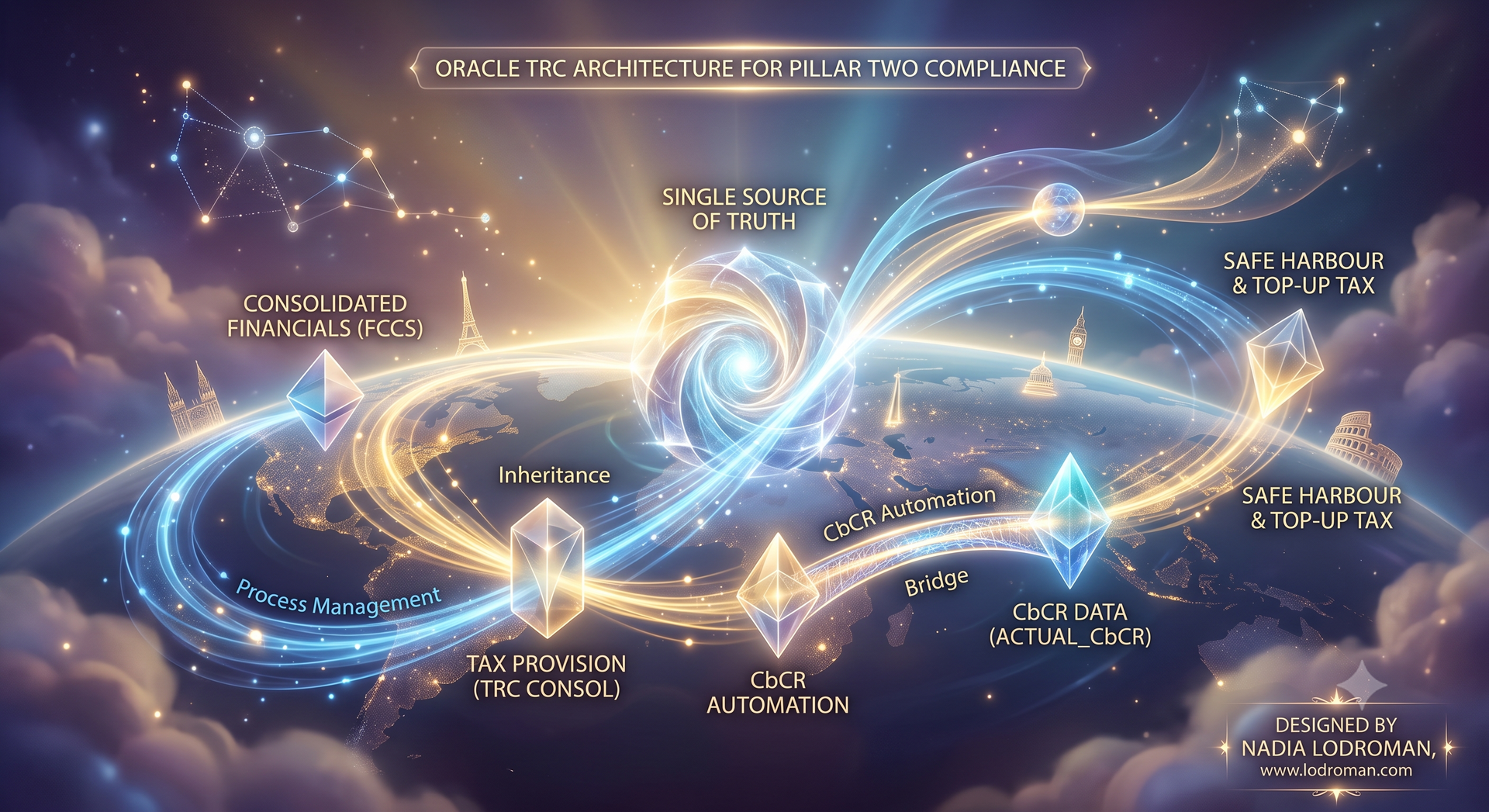
Does Oracle TRC handle Country-by-Country Reporting (CbCR)?
Yes. Oracle Tax Reporting Cloud (TRC) provides built-in frameworks to automate Country-by-Country Reporting, ensuring multinational organizations remain compliant with global BEPS (Base Erosion and Profit Shifting) regulations.
How does Oracle TRC integrate with FCCS?
TRC and FCCS share the same platform architecture, allowing for seamless data flow. Finalized pre-tax consolidated data from FCCS feeds directly into TRC for tax provisioning, ensuring perfect alignment between the finance and tax departments.
Still have a question?
All things Oracle EPM