The Cost of Silence
Nadia Lodroman | Oracle EPM Consultant | Integrity in Every Insight.
Listen to Tresora and Ledgeron's chatting about this blog post:
Why Leaving Your Oracle Tax Reporting (TRCS) Application Idle for 11 Months is a Compliance Disaster
Every year, around late December, a familiar script plays out in corporate tax departments worldwide. The air gets colder, the holiday decorations go up, and a sudden wave of anxiety washes over the tax team. It’s time to open up the tax provision software.
Having spent the better part of my career steering global tax and accounting processes through intense closing cycles, I’ve seen this script play out dozens of times. Companies invest hundreds of thousands of dollars into cutting-edge cloud technology, only to treat it like a heavy digital winter coat. They pack it away in the closet for 11 months, completely out of sight and mind, fully expecting to pull it out in January, shake off the dust, and have it fit perfectly.
But the cloud doesn’t work like a winter coat. And treating it like one is a fast track to a compliance trainwreck.
The Day After Go-Live (and the Myth of "Set-and-Forget")
We all know the feeling of crossing an implementation finish line. After months of mapping data, building calculation scripts, and enduring endless testing cycles, your Oracle Tax Reporting Cloud Service (TRCS) platform finally goes live. The project team celebrates, the consultants pack up, and the tax department sighs a collective relief.
Because tax teams are perpetually buried under compliance deadlines, the temptation to walk away from a newly finished system is massive. The prevailing mindset becomes:
"The system works. Let’s leave it alone until we actually need it for year-end."
This is where the hidden
Oracle TRCS implementation risks begin to take root. TRCS isn't a static spreadsheet safely tucked away in a local folder; it’s a dynamic, highly integrated corporate engine. When you isolate it from your monthly financial workflows and let it sit in total silence, you aren’t just preserving it—you are actively setting the stage for catastrophic
Tax Provision automation failures when the stakes are highest.
The Phantom in My Garage
To understand what happens to your software while you’re ignoring it, look at my garage.
I own an electric BMW i3. It is a brilliant, highly sophisticated piece of German engineering. But because I don't drive it every single day, I ran into a bizarre problem: its 12v auxiliary battery kept going completely flat every forty-eight hours.
I quickly learned that even when the car is parked, turned off, and the keys are inside the house, it is never truly "asleep." Under the hood, a dozen background systems are constantly awake and drawing power. The GPS is tracking, the electronic parking brake is monitoring itself, the proximity sensors for the doors are waiting, and the window modules are on standby. Because the car isn't being driven, the main battery never gets the chance to recharge the auxiliary systems, and the whole machine stalls.
Your TRCS application operates exactly like my BMW.
The Technical Reality: The Cloud Never Sleeps
When you leave your application sitting idle, it isn't frozen in time. While your tax team is focused on other projects, Oracle is busy under the hood.
Every single month, without exception, Oracle deploys
Oracle EPM monthly updates. These automatic rollouts introduce security patches, underlying code enhancements, and new system features.
When your application sits untouched for nearly a year, it undergoes 11 consecutive update cycles completely unsupervised. This creates a phenomenon known as platform drift.
A minor change in metadata structure in March, combined with a modified calculation script enhancement in August, can quietly break the custom logic your team built during implementation. Because no one is logging in to validate the code or check the data forms against these monthly updates, the system degrades in the dark. You won't know the engine is dead until you try to turn the key in January - leaving you zero time to fix it before your reporting deadline.
The Human Cost: Total System Amnesia
It isn’t just the software that suffers from platform drift; your team does too.
TRCS is an incredibly powerful automation engine, but it requires regular practice to navigate confidently. When a tax team only logs into a complex system once a year, they don't return to it as experts. Instead, they experience a collective, frustrating system amnesia.
The first two critical weeks of the year-end close - weeks that should be spent on high-level strategic analysis and risk management - are instead wasted on frantic operational questions:
- “Where did we map that specific temporary difference last year?”
- “How do we trigger the automated tax overrides again?”
- “Why isn't the consolidated ETR rolling up correctly?”
By treating the tool as a year-end guest rather than a monthly partner, your team loses the muscle memory required to run an efficient close.
The Remedy: Taking the Machine for a Long Drive
You do not have to live in a state of perpetual year-end panic. The remedy to this compliance risk is simple: your highly sophisticated automation engine just needs to be taken out for a spin every now and then.
Instead of a frantic, once-a-year scramble, the goal should be to design a phased roadmap that transitions your department toward a continuous, proactive quarterly close process.
This is exactly where bringing in an
Oracle EPM consultant
expert can change the game. By establishing a lightweight, routine health-check framework, you can:
- Validate monthly updates against your specific corporate tax logic in real-time.
- Keep your team's skills sharp through small, manageable quarterly touchpoints.
- Catch data anomalies early, ensuring your year-end close is a non-event.
Let’s Get Your Application Back on the Road
If your corporate tax application has been sitting idle in the dark, or if you are currently staring down the barrel of an implementation that feels like it’s slipping away, let's fix it before the winter rush hits.
I specialize in implementation rescues, proactive health checks, and building sustainable roadmaps that keep your technology running smoothly year-round.
Don't let your automation engine sit until the battery dies.
Visit
www.lodroman.com today to book a advisory consultation, and let's ensure your tax technology is firing on all cylinders when you need it most.
Turning financial complexity into operational clarity. Because in Finance, Integrity is Permanent.
General EPM Strategy FAQs
Why should a company use EPM Automate instead of custom scripting
EPM Automate allows for robust, bi-directional data orchestration between Oracle EPM and source ERPs (like NetSuite or Fusion) using native capabilities. It is highly scalable, easier to maintain during Oracle's monthly updates, and avoids the fragility of heavy custom coding.
Can Oracle Cloud EPM integrate with multiple different ERPs simultaneously?
Yes. Through strategic data pipeline architecture, Oracle EPM can ingest, consolidate, and even write-back finalized data to multiple disparate ERPs concurrently, acting as the single source of truth for the enterprise.
How does Oracle FCCS handle Minority Interest (NCI) and CTA?
While standard FCCS provides out-of-the-box functionality, complex global enterprises often require advanced configuration to isolate and calculate Minority Interest (NCI) and Cumulative Translation Adjustments (CTA) accurately at the top consolidated hierarchy without relying on manual journals.
Can you bypass the out-of-the-box Goodwill calculation in Oracle FCCS?
Yes. By utilizing advanced native configuration and custom consolidation rules, you can bypass standard Goodwill Input/Offset functionality to meet highly specific, non-standard acquisition accounting requirements.
How many daily transactions can Oracle ARCS process?
Oracle ARCS is built for enterprise scale. With proper architecture in the Transaction Matching engine, ARCS can easily process and auto-match hundreds of thousands of daily banking transactions, representing billions of dollars in value.
What is the difference between Transaction Matching and Reconciliation Compliance in ARCS?
Transaction Matching automates the high-volume, line-by-line matching of data (like daily bank feeds or ACH). Reconciliation Compliance is used to govern the period-end justification of broader balance sheet account balances.
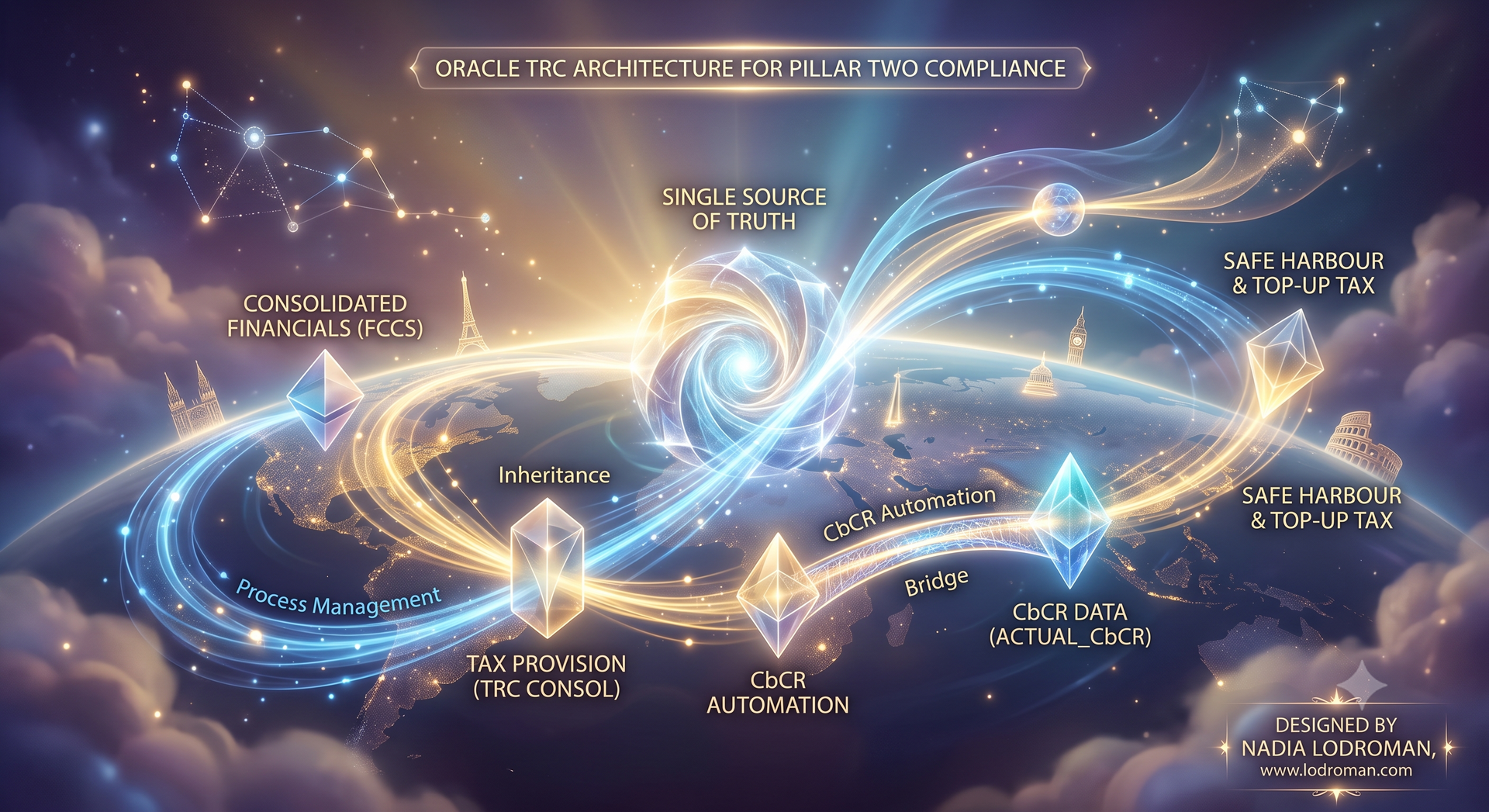
Does Oracle TRC handle Country-by-Country Reporting (CbCR)?
Yes. Oracle Tax Reporting Cloud (TRC) provides built-in frameworks to automate Country-by-Country Reporting, ensuring multinational organizations remain compliant with global BEPS (Base Erosion and Profit Shifting) regulations.
How does Oracle TRC integrate with FCCS?
TRC and FCCS share the same platform architecture, allowing for seamless data flow. Finalized pre-tax consolidated data from FCCS feeds directly into TRC for tax provisioning, ensuring perfect alignment between the finance and tax departments.
Still have a question?
All things Oracle EPM