The $20,000 Pillar Two Assessment Trap
Nadia Lodroman | Oracle EPM Consultant | Integrity in Every Insight.
Listen to Tresora and Ledgeron's chatting about this blog post:
Why Your TRCS Architecture Needs a Surgeon, Not a Generalist
The $20,000 Pillar Two Assessment Trap: Why Your TRCS Architecture Needs a Surgeon, Not a Generalist
Right now, Pillar Two is dominating the tax technology space. As an independent Oracle EPM Consultant, I am seeing a massive influx of companies paying $15,000 to $20,000 for "Pillar Two Readiness Assessments" - only to be handed a generic checklist that misses the foundational flaws of their Oracle Tax Reporting Cloud (TRCS) environments.
Here is a harsh reality I’ve learned from 20 years in finance - from my days as Regional Chief Controller at Yahoo to managing Global Intercompany at Oath, and later architecting deals internally at Oracle:
You cannot build a compliant Pillar Two solution on a fundamentally misunderstood TRCS architecture. And throwing a generic "fast-track" implementation at it will only make it worse.
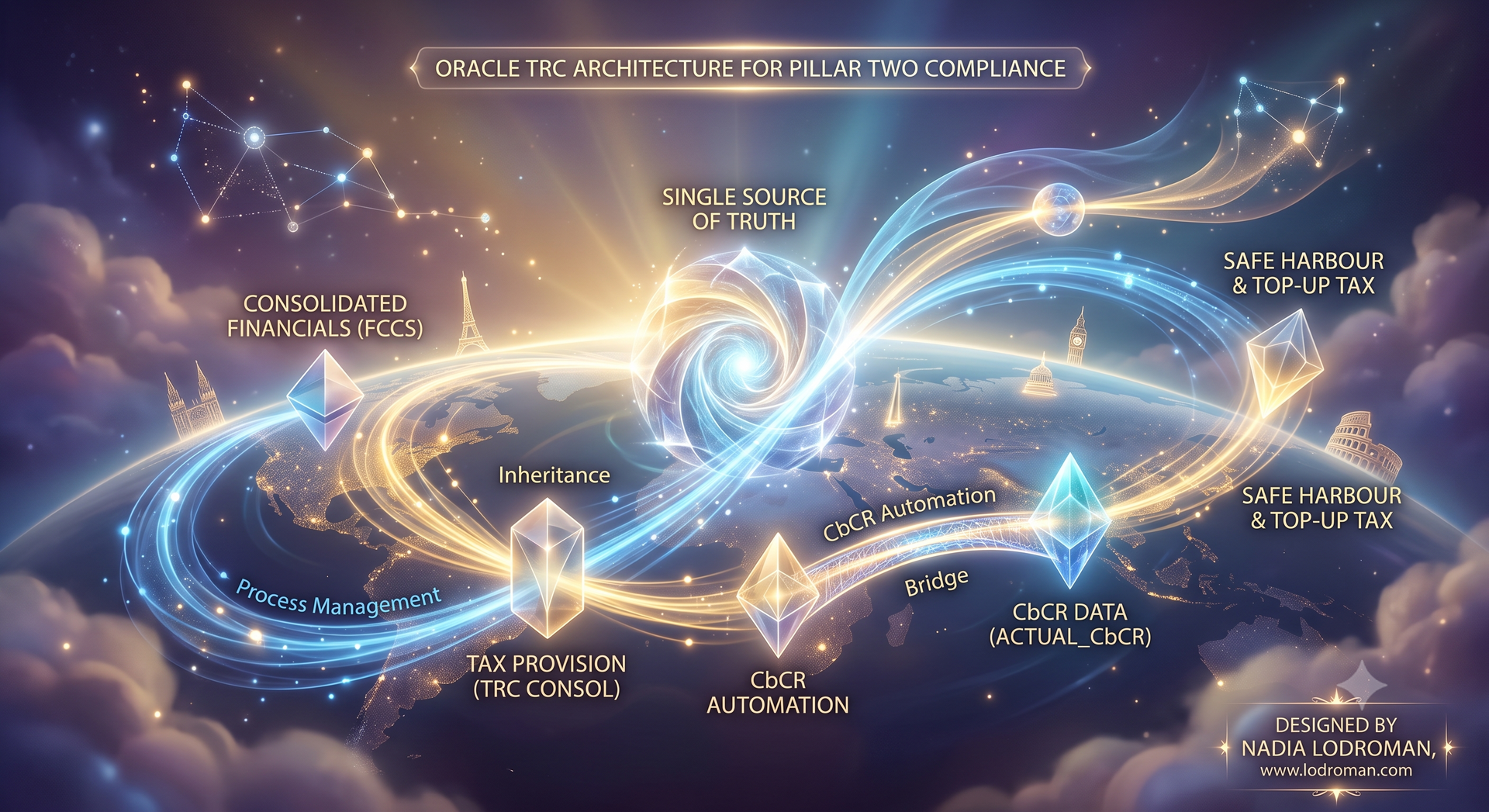
Recently, I was brought in to review a TRCS implementation for a client preparing for Pillar Two. During my architectural walkthrough, I found a fatal flaw in their foundation: they had built one Scenario for "Actuals" (used for the corporate provision) and a completely separate, disconnected Scenario for CbCR. They were running dual data loads.
I didn’t even need to ask the previous implementation partner why they built it this way; the metadata told the whole story. The prior architect had clearly treated TRCS like a generic EPM Planning application - spinning up distinct scenarios and building custom calculation silos just to get numbers on a screen.
Here is what they didn't understand, and what every Tax and Finance leader needs to know:
Oracle explicitly architected TRCS, CbCR, and Pillar Two to function as a unified, single source of truth.
When architected correctly, the exact same foundational data flows through distinct, interconnected automation rules. The data used to compute your corporate provision should seamlessly drive your CbCR, which in turn provides the bedrock for your Pillar Two top-up tax and safe harbor evaluations.
By treating TRCS like a custom Planning app and splitting the provision and CbCR into isolated silos, the previous implementers:
- Guaranteed a future mismatch between provision data and CbCR data.
- Forced the manual duplication of complex automation rules (tax losses, credits, TAR, ETR).
- Created a massive, unnecessary audit risk precisely when Pillar Two is demanding unprecedented data transparency.
The Danger of the "Easy" Fix
Some implementation partners will charge you $20k just to point out the flaw I just described above. But identifying the dual-scenario mistake is only 10% of the battle.
The real challenge - the "surgery" - is fixing it. Merging disconnected scenarios and re-aligning jurisdictional metadata (like mapping US States to Regional rather than National hierarchies) without destroying your historical data or disrupting your current financial close requires deep, specialized expertise. An IT generalist cannot fix this; you need an architect who understands the intricacies of the tax code, EPM Data Integration, and TRCS metadata redesign.
The "dual-scenario" approach might work for a standard FP&A process, but it will not survive a Pillar Two audit.
Are you confident in your TRCS foundation? Before you spend tens of thousands on a generic readiness assessment, let's look at the actual architecture.
I am currently taking on new advisory, remediation, and implementation projects. Let’s collaborate.
Drop me a message at nadia@lodroman.com, or visit my website at www.lodroman.com to discuss how we can secure your Pillar Two readiness with a true single-source architecture.
Turning financial complexity into operational clarity. Because in Finance, Integrity is Permanent.
General EPM Strategy FAQs
Why should a company use EPM Automate instead of custom scripting
EPM Automate allows for robust, bi-directional data orchestration between Oracle EPM and source ERPs (like NetSuite or Fusion) using native capabilities. It is highly scalable, easier to maintain during Oracle's monthly updates, and avoids the fragility of heavy custom coding.
Can Oracle Cloud EPM integrate with multiple different ERPs simultaneously?
Yes. Through strategic data pipeline architecture, Oracle EPM can ingest, consolidate, and even write-back finalized data to multiple disparate ERPs concurrently, acting as the single source of truth for the enterprise.
How does Oracle FCCS handle Minority Interest (NCI) and CTA?
While standard FCCS provides out-of-the-box functionality, complex global enterprises often require advanced configuration to isolate and calculate Minority Interest (NCI) and Cumulative Translation Adjustments (CTA) accurately at the top consolidated hierarchy without relying on manual journals.
Can you bypass the out-of-the-box Goodwill calculation in Oracle FCCS?
Yes. By utilizing advanced native configuration and custom consolidation rules, you can bypass standard Goodwill Input/Offset functionality to meet highly specific, non-standard acquisition accounting requirements.
How many daily transactions can Oracle ARCS process?
Oracle ARCS is built for enterprise scale. With proper architecture in the Transaction Matching engine, ARCS can easily process and auto-match hundreds of thousands of daily banking transactions, representing billions of dollars in value.
What is the difference between Transaction Matching and Reconciliation Compliance in ARCS?
Transaction Matching automates the high-volume, line-by-line matching of data (like daily bank feeds or ACH). Reconciliation Compliance is used to govern the period-end justification of broader balance sheet account balances.
Does Oracle TRC handle Country-by-Country Reporting (CbCR)?
Yes. Oracle Tax Reporting Cloud (TRC) provides built-in frameworks to automate Country-by-Country Reporting, ensuring multinational organizations remain compliant with global BEPS (Base Erosion and Profit Shifting) regulations.
How does Oracle TRC integrate with FCCS?
TRC and FCCS share the same platform architecture, allowing for seamless data flow. Finalized pre-tax consolidated data from FCCS feeds directly into TRC for tax provisioning, ensuring perfect alignment between the finance and tax departments.
Still have a question?
All things Oracle EPM