The Sub-ledger Revolution
Nadia Lodroman | Oracle EPM Consultant | Integrity in Every Insight.
Listen to Tresora and Ledgeron's chatting about this blog post:
Bridging the "Data Gap" Between Fusion ERP and Oracle TRC
For years, the standard operating procedure for Tax Reporting Cloud (TRC) implementations has been a simple, high-level integration with the General Ledger. The logic was straightforward: if the numbers are good enough for the financial close in FCCS, they are good enough for the tax provision. However, as global tax mandates like Pillar Two and increased local statutory scrutiny become the norm, this "Trial Balance-only" philosophy is beginning to crumble. A summarized TB is essentially a "black box"—it tells you the total expense, but it hides the tax-sensitive details that actually drive the provision.
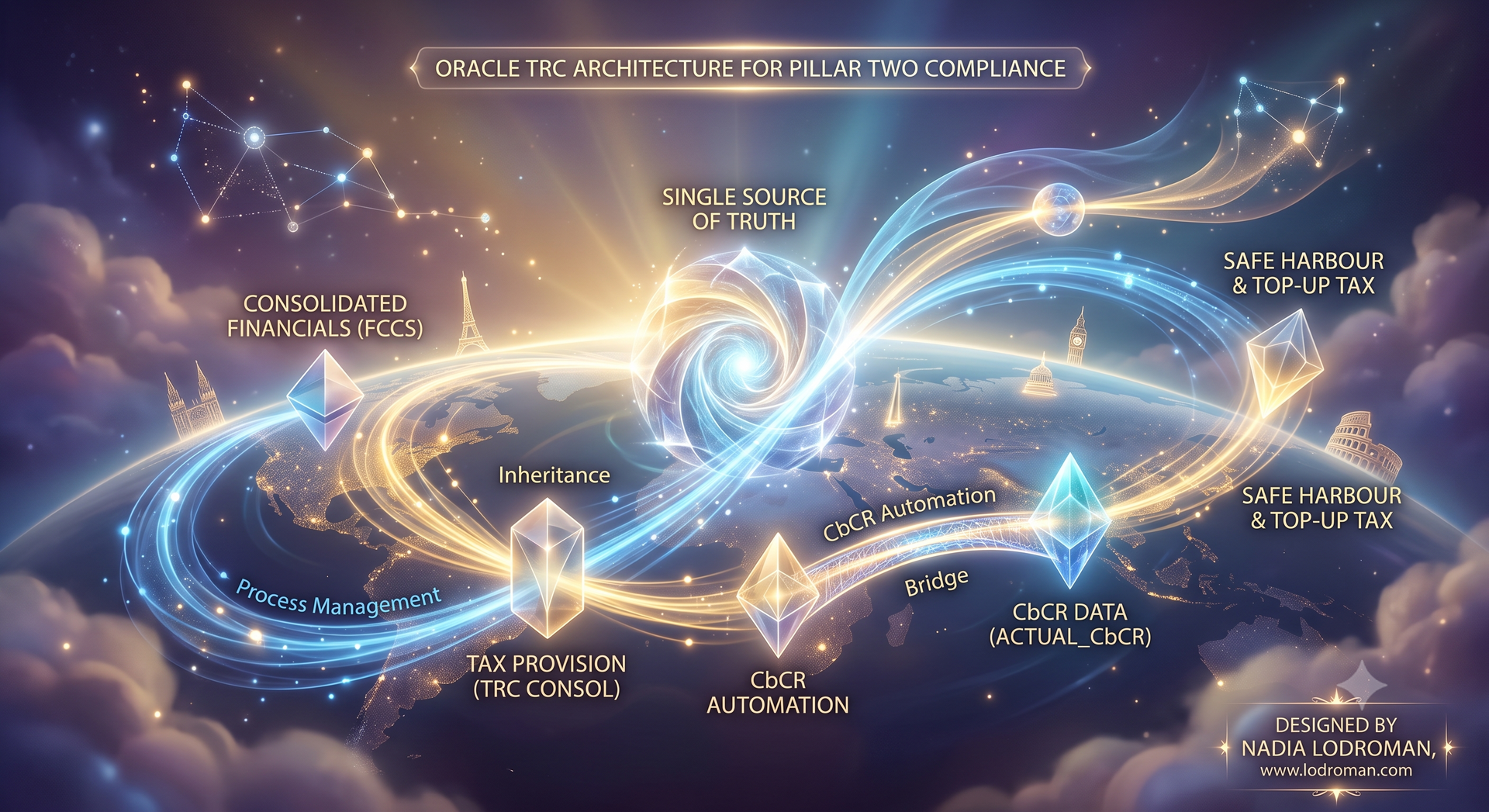
We believe the next generation of tax technology isn't found in better spreadsheets, but in deeper "plumbing." The most successful implementations today are those that bypass the summarized GL and tap directly into the source: the Oracle Fusion Sub-ledgers. By utilizing BI Publisher (BIP) as a direct data conduit, we can transform TRC from a reactive calculation tool into a proactive, audit-ready tax data warehouse.
The Technical "Magic": Consuming BI Publisher Reports
The traditional hurdle to sub-ledger reporting has always been the sheer volume and complexity of the data. Manually exporting CSVs from Accounts Payable or Fixed Assets to build a tax pack is a recipe for version-control nightmares. Oracle TRC solves this through the Data Exchange (formerly Data Management) framework, which allows the system to natively "consume" BI Publisher reports directly from the Oracle Fusion environment.
This integration is a game-changer because it allows the tax architect to write highly specific SQL queries within Fusion to isolate tax-relevant transactions. Instead of waiting for a manual upload, TRC calls the BIP report, fetches the granular data—including invoice descriptions, vendor tax IDs, and project codes—and streams it directly into the tax workbench. This moves the tax department away from being a "data requester" and makes them a "data consumer," with the ability to refresh their sub-ledger insights at the click of a button.
From AP to Fixed Assets: Where the Value Lives
The power of this integration is best seen in the details. In the Accounts Payable module, for instance, a standard GL account might show a million-dollar "Marketing Expense." A BIP report, however, can identify which of those invoices include non-deductible entertainment or specific tax-exempt vendor payments.
Similarly, in the Fixed Assets module, TRC can consume BIP reports to reconcile book-to-tax depreciation differences at the asset level. Rather than entering a single top-side adjustment for the entire company, the system can ingest the specific asset lives and methods used in the statutory books, providing a level of precision that makes the year-end audit a non-event. This granularity is no longer a luxury; it is the fundamental requirement for calculating the Substance-Based Income Exclusion under Pillar Two rules, where the carrying value of tangible assets must be known with absolute certainty.
Solving the Pillar Two "Data Hunger"
The OECD’s Global Minimum Tax (GloBE) rules have created a "data hunger" that most legacy tax systems cannot satisfy. Pillar Two requires tax teams to "re-cast" deferred taxes and analyze profits with a level of jurisdictional granularity that simply doesn't exist in a high-level Trial Balance.
By leveraging BI Publisher reports to extract project-level costing or task-based R&D spending from the Project Management modules, tax teams can automatically qualify for safe harbors or identify credits that significantly impact the Jurisdictional Effective Tax Rate (ETR). This isn't just about compliance; it's about optimization. When you have sub-ledger visibility, you can identify tax-saving opportunities that are invisible in a summarized ledger.
A New Standard for Tax Governance
The goal of a modern TRC implementation should be the elimination of the "Tax Pack" entirely. By architecting a direct line between Oracle Fusion BI Publisher and Tax Reporting Cloud, we create a single, immutable chain of custody for every dollar reported to a tax authority. This is the "Lodroman" standard: a system where the tax provision is not an estimate, but a documented reflection of every transaction occurring in the sub-ledger. In an era of unprecedented transparency, the organizations that own their sub-ledger data will be the ones that navigate the future of global tax with confidence.
Turning financial complexity into operational clarity. Because in Finance, Integrity is Permanent.
General EPM Strategy FAQs
Why should a company use EPM Automate instead of custom scripting
EPM Automate allows for robust, bi-directional data orchestration between Oracle EPM and source ERPs (like NetSuite or Fusion) using native capabilities. It is highly scalable, easier to maintain during Oracle's monthly updates, and avoids the fragility of heavy custom coding.
Can Oracle Cloud EPM integrate with multiple different ERPs simultaneously?
Yes. Through strategic data pipeline architecture, Oracle EPM can ingest, consolidate, and even write-back finalized data to multiple disparate ERPs concurrently, acting as the single source of truth for the enterprise.
How does Oracle FCCS handle Minority Interest (NCI) and CTA?
While standard FCCS provides out-of-the-box functionality, complex global enterprises often require advanced configuration to isolate and calculate Minority Interest (NCI) and Cumulative Translation Adjustments (CTA) accurately at the top consolidated hierarchy without relying on manual journals.
Can you bypass the out-of-the-box Goodwill calculation in Oracle FCCS?
Yes. By utilizing advanced native configuration and custom consolidation rules, you can bypass standard Goodwill Input/Offset functionality to meet highly specific, non-standard acquisition accounting requirements.
How many daily transactions can Oracle ARCS process?
Oracle ARCS is built for enterprise scale. With proper architecture in the Transaction Matching engine, ARCS can easily process and auto-match hundreds of thousands of daily banking transactions, representing billions of dollars in value.
What is the difference between Transaction Matching and Reconciliation Compliance in ARCS?
Transaction Matching automates the high-volume, line-by-line matching of data (like daily bank feeds or ACH). Reconciliation Compliance is used to govern the period-end justification of broader balance sheet account balances.
Does Oracle TRC handle Country-by-Country Reporting (CbCR)?
Yes. Oracle Tax Reporting Cloud (TRC) provides built-in frameworks to automate Country-by-Country Reporting, ensuring multinational organizations remain compliant with global BEPS (Base Erosion and Profit Shifting) regulations.
How does Oracle TRC integrate with FCCS?
TRC and FCCS share the same platform architecture, allowing for seamless data flow. Finalized pre-tax consolidated data from FCCS feeds directly into TRC for tax provisioning, ensuring perfect alignment between the finance and tax departments.
Still have a question?
All things Oracle EPM