A Welcome Integration: How EPM's 25.11 Update Streamlines Match Type Changes
Nadia Lodroman | Oracle EPM Consultant | Integrity in Every Insight.
Listen to Tresora and Ledgeron's chatting about this blog post:
Learn how the November 25.11 release for Account Reconciliation removes manual data sync work and saves EPM admins valuable time.
- ID of a match type
- ID of a data source (a key field, which we know is often used for creating Transaction Matching reports)
- ID of a data source attribute
- Name of a journal column
- For Service Admins: You get your time back. Every minute not spent on tedious, manual data-syncing is a minute that can be reinvested in high-value tasks like optimizing rules, building better reports, or training your users.
- For Data Governance: This update makes your data connections more robust. By automating the sync, you eliminate the risk of human error. Your data integrations will always be aligned with your reconciliation definitions, which means more reliable data.
- For the Business: It's all about agility. This update removes a key point of friction in your EPM ecosystem. It makes the entire platform more resilient, easier to maintain, and faster to adapt—which is exactly what you need for a faster, more accurate close.
- Evaluation of User Roles: A change in how user roles are evaluated when determining the validity of profiles.
- Auto Submit Reconciliation Rules: A change in the eligibility criteria for auto-submit rules.
- Evaluation of Invalid Mappings: A change in how invalid mappings are evaluated.
Turning financial complexity into operational clarity. Because in Finance, Integrity is Permanent.
General EPM Strategy FAQs
Why should a company use EPM Automate instead of custom scripting
EPM Automate allows for robust, bi-directional data orchestration between Oracle EPM and source ERPs (like NetSuite or Fusion) using native capabilities. It is highly scalable, easier to maintain during Oracle's monthly updates, and avoids the fragility of heavy custom coding.
Can Oracle Cloud EPM integrate with multiple different ERPs simultaneously?
Yes. Through strategic data pipeline architecture, Oracle EPM can ingest, consolidate, and even write-back finalized data to multiple disparate ERPs concurrently, acting as the single source of truth for the enterprise.
How does Oracle FCCS handle Minority Interest (NCI) and CTA?
While standard FCCS provides out-of-the-box functionality, complex global enterprises often require advanced configuration to isolate and calculate Minority Interest (NCI) and Cumulative Translation Adjustments (CTA) accurately at the top consolidated hierarchy without relying on manual journals.
Can you bypass the out-of-the-box Goodwill calculation in Oracle FCCS?
Yes. By utilizing advanced native configuration and custom consolidation rules, you can bypass standard Goodwill Input/Offset functionality to meet highly specific, non-standard acquisition accounting requirements.
How many daily transactions can Oracle ARCS process?
Oracle ARCS is built for enterprise scale. With proper architecture in the Transaction Matching engine, ARCS can easily process and auto-match hundreds of thousands of daily banking transactions, representing billions of dollars in value.
What is the difference between Transaction Matching and Reconciliation Compliance in ARCS?
Transaction Matching automates the high-volume, line-by-line matching of data (like daily bank feeds or ACH). Reconciliation Compliance is used to govern the period-end justification of broader balance sheet account balances.
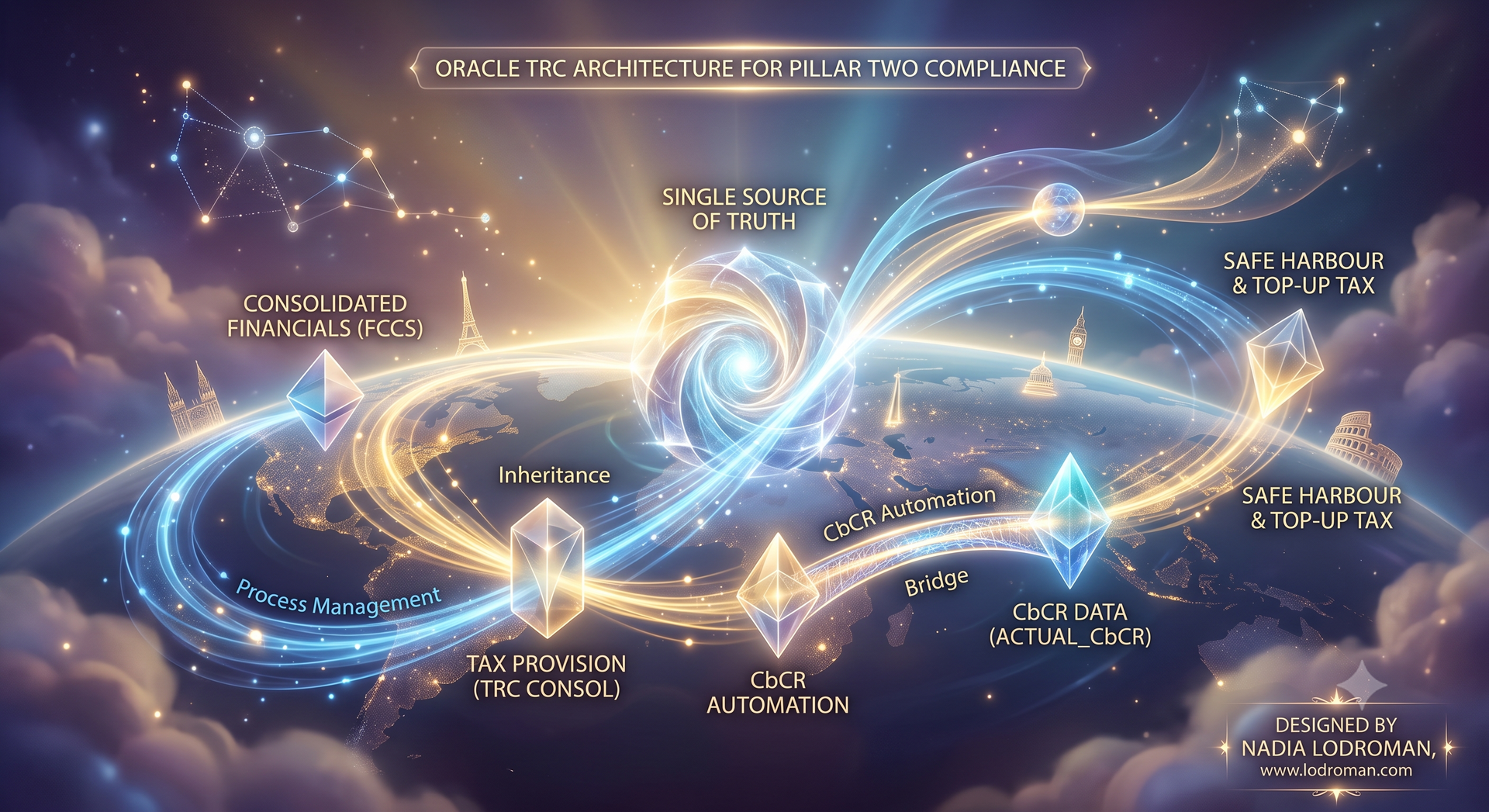
Does Oracle TRC handle Country-by-Country Reporting (CbCR)?
Yes. Oracle Tax Reporting Cloud (TRC) provides built-in frameworks to automate Country-by-Country Reporting, ensuring multinational organizations remain compliant with global BEPS (Base Erosion and Profit Shifting) regulations.
How does Oracle TRC integrate with FCCS?
TRC and FCCS share the same platform architecture, allowing for seamless data flow. Finalized pre-tax consolidated data from FCCS feeds directly into TRC for tax provisioning, ensuring perfect alignment between the finance and tax departments.
Still have a question?
All things Oracle EPM