The Governance & Security Power-Up in Oracle EPM 26.04
Nadia Lodroman | Oracle EPM Consultant | Integrity in Every Insight.
Listen to Tresora and Ledgeron's chatting about this blog post:
New Governance & Security Features Guide
After a brief but notable hiatus since version 25.10, Oracle EPM is officially back on its monthly release cadence this April 2026. For those of us navigating the technical architecture of these environments, the 26.04 update feels like a turning point. It’s no longer just about adding "more features"; it’s about refining the administrative "scalpel." This month’s theme is all about Governance and Security - moving away from broad-brush permissions toward a model of granular, transparent control.
The New Gold Standard: Break Glass Functionality
Perhaps the most significant "Enterprise-grade" addition in this release is the introduction of Break Glass functionality. In highly regulated sectors like FinServ or Healthcare, the "black box" of cloud support has always been a point of friction with CISO departments. Previously, Oracle Support access followed standard service request protocols, but the new Break Glass model shifts the power dynamic entirely to the customer.
From a technical standpoint, this allows organizations to enforce a "No-Trust" architecture. When a critical backend issue arises, Oracle personnel cannot simply access your environment or database; they require an explicit, time-bound "key" granted by your internal admins. This provides a verifiable audit trail that proves exactly who was in the system and for how long. It effectively eliminates the anxiety of unauthorized data exposure and satisfies the most stringent data sovereignty requirements.
Precision Engineering in Data Integration
Moving into the day-to-day operations of a Center of Excellence (CoE), the 26.04 update addresses a long-standing grievance regarding role rigidity in Data Integration. Historically, the permissions surrounding integration were often an "all or nothing" affair. This created a significant risk profile where a user tasked with simply running a data load could inadvertently modify a complex SQL mapping or alter a period mapping.
Oracle has solved this by allowing for the
Customization of Data Integration Roles. By decoupling the ability to "Create" from the ability to "Run," and further granularizing actions like "Edit Mapping" or "Manage Category Mapping," we can finally apply the
Principle of Least Privilege. For the technical lead, this means you can empower your business users to trigger integrations while keeping the underlying logic—the "plumbing"—safely under lock and key. It’s a massive step forward in reducing accidental downtime caused by "fat-fingered" metadata changes.
Closing the Accountability Gap in ARCS
Account Reconciliation (ARCS) has also seen a major boost in its audit capabilities, specifically regarding Team Management. In a global close process, Teams are the engine that keeps reconciliations moving. However, tracking the "who and when" of team membership was a notorious blind spot. If a reconciliation went unaddressed because a user was quietly removed from a team, the "why" was often lost to time.
With 26.04, user changes to Teams are now natively captured within the Audit Report. By filtering for the "Team" object within the Reconciliation Compliance tab, admins gain a transparent, timestamped history of every addition and deletion. This isn't just about catching mistakes; it’s about defensibility. When external auditors ask why a specific workflow changed mid-close, you no longer have to play detective—the system provides the answer with a single click.
Extending the Reach: External Users
Finally, the update introduces a more inclusive way to handle exception management by allowing for the Creation and Management of External Users directly within Access Control. This is a brilliant architectural move for managing global workflows. Many reconciliations require input from stakeholders who don't live in the EPM world—think IT hardware managers or third-party logistics providers.
Instead of requiring these stakeholders to hold a full license or forcing the Finance team to act as "manual relayers" via email, you can now add them as
External Users. These individuals can be assigned as Notification Assignees or Viewers on Alerts. They get the information they need to resolve a discrepancy without needing to navigate the complexities of the full EPM interface. This breaks down the silos between Finance and the rest of the business, accelerating the close cycle and ensuring that no alert falls through the cracks.
Looking Ahead
The 26.04 release isn't just a patch; it's a statement that Oracle EPM is maturing into a platform that respects the complexity of modern IT governance.
Next week, we’ll shift our focus from the "back office" of administration to the "front line" of the user experience. We will explore how AI is starting to reshape the way we interact with our data.
Expert Guidance for Your EPM Journey Navigating these robust governance updates requires a strategic roadmap tailored to your organization’s unique compliance needs. For specialized advice on optimizing your Oracle EPM environment and staying ahead of the 2026 release cycle, contact
Nadia Lodroman at www.lodroman.com.
Turning financial complexity into operational clarity. Because in Finance, Integrity is Permanent.
General EPM Strategy FAQs
Why should a company use EPM Automate instead of custom scripting
EPM Automate allows for robust, bi-directional data orchestration between Oracle EPM and source ERPs (like NetSuite or Fusion) using native capabilities. It is highly scalable, easier to maintain during Oracle's monthly updates, and avoids the fragility of heavy custom coding.
Can Oracle Cloud EPM integrate with multiple different ERPs simultaneously?
Yes. Through strategic data pipeline architecture, Oracle EPM can ingest, consolidate, and even write-back finalized data to multiple disparate ERPs concurrently, acting as the single source of truth for the enterprise.
How does Oracle FCCS handle Minority Interest (NCI) and CTA?
While standard FCCS provides out-of-the-box functionality, complex global enterprises often require advanced configuration to isolate and calculate Minority Interest (NCI) and Cumulative Translation Adjustments (CTA) accurately at the top consolidated hierarchy without relying on manual journals.
Can you bypass the out-of-the-box Goodwill calculation in Oracle FCCS?
Yes. By utilizing advanced native configuration and custom consolidation rules, you can bypass standard Goodwill Input/Offset functionality to meet highly specific, non-standard acquisition accounting requirements.
How many daily transactions can Oracle ARCS process?
Oracle ARCS is built for enterprise scale. With proper architecture in the Transaction Matching engine, ARCS can easily process and auto-match hundreds of thousands of daily banking transactions, representing billions of dollars in value.
What is the difference between Transaction Matching and Reconciliation Compliance in ARCS?
Transaction Matching automates the high-volume, line-by-line matching of data (like daily bank feeds or ACH). Reconciliation Compliance is used to govern the period-end justification of broader balance sheet account balances.
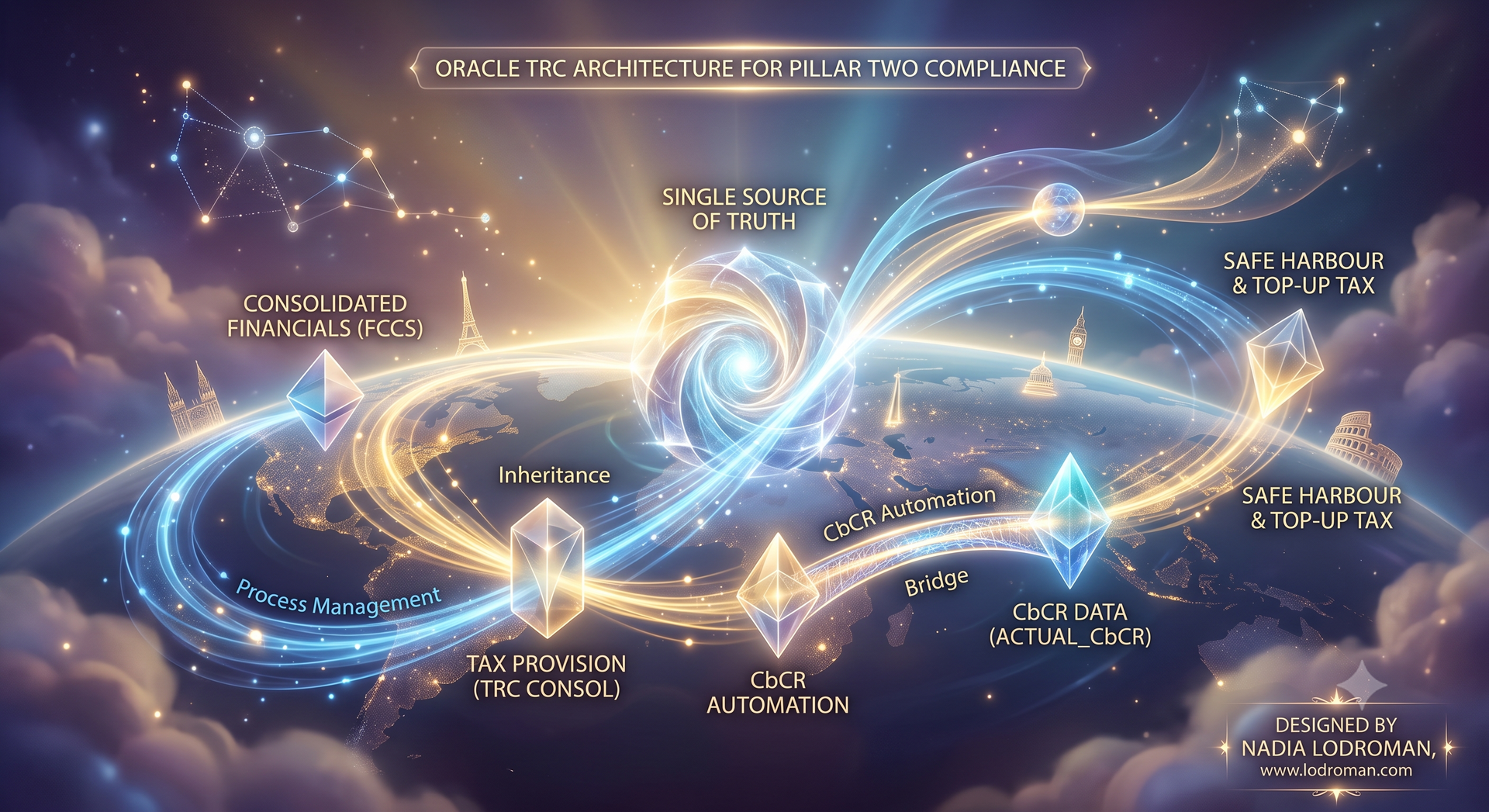
Does Oracle TRC handle Country-by-Country Reporting (CbCR)?
Yes. Oracle Tax Reporting Cloud (TRC) provides built-in frameworks to automate Country-by-Country Reporting, ensuring multinational organizations remain compliant with global BEPS (Base Erosion and Profit Shifting) regulations.
How does Oracle TRC integrate with FCCS?
TRC and FCCS share the same platform architecture, allowing for seamless data flow. Finalized pre-tax consolidated data from FCCS feeds directly into TRC for tax provisioning, ensuring perfect alignment between the finance and tax departments.
Still have a question?
All things Oracle EPM