A Birthday, a Valentine, and a Win-Win
Nadia Lodroman | Oracle EPM Consultant | Integrity in Every Insight.
Listen to Tresora and Ledgeron's chatting about this blog post:
Why Your Finance Team Needs More Than a Token of Appreciation This Spring
We are entering a season of global celebrations. From the romantic gestures of Valentine’s Day to the advocacy of International Women’s Day, and the family traditions of Easter, the next few months are a marathon of "appreciation."
But for most finance departments, these milestones are just dates on a calendar that happen to fall during the "close."
Interestingly, February 14th is also Oracle EPM’s birthday. It seems fitting that a solution designed to bring "heart" back to the finance function by eliminating manual drudgery shares its anniversary with a day of appreciation.
As someone who has spent 20 years in the accounting trenches - from CFO of an automotive manufacturer to EMEA Regional Controller - I’ve seen the toll this takes. I recently missed my own life partner’s birthday celebrations due to work commitments. It’s a familiar story in our industry, but it shouldn't be the standard.
While small tokens of appreciation like flowers or office lunches are nice, they don't solve the underlying problem. Giving personal time back to your employees while improving your financial statement accuracy - with a fully auditable and automated workflow - is a true win-win for both companies and the accountants of the world.
Moving from Manual To Meaningful
Instead of temporary gestures, let’s give our teams a permanent technical solution. Here is how Oracle EPM transforms the "holiday close" from a sacrifice into a streamlined process.
1. The Gift of Focus: Account Reconciliation (ARCS)
Manual reconciliations are the ultimate "time-thieves." By implementing Oracle ARCS, you automate the mundane.
- Auto-Reconciliation: Let the system handle the low-risk, zero-balance, or recurring accounts.
- High-Volume Matching: Stop the manual tick-and-bash of bank and intercompany files. Your team shouldn't spend their Valentine’s Day evening matching bank lines; they should be out at dinner.
2. The Gift of Predictability: Financial Consolidation (FCCS)
The stress of the close often comes from the unknown. Oracle FCCS provides a centralized Task Manager that turns chaos into a visible, manageable workflow. Automated eliminations and translations mean your team isn't waiting around for spreadsheets to update—they are moving toward the finish line together, efficiently.
3. The "Time-Back Egg": Precision in Tax Reporting (TRCS)
Tax reporting is often the final hurdle, frequently falling right over the Easter break. Oracle TRCS automates the "last mile" by integrating tax provisions directly with the corporate close. Automating NOL and RTA calculations ensures that "getting the tax numbers right" doesn't mean missing the family gathering.
4. The Gift of Collaboration: Narrative Reporting
The final push for the quarterly report shouldn't be a frantic email chain. Narrative Reporting allows your best people to collaborate on the same document simultaneously, with clear audit trails. It removes the "version control" nightmare that keeps people in the office until midnight.
The Bottom Line: Values vs. Action
When a company says they value their employees' "Work-Life Balance," the proof is in the toolkit they provide.
Equipping your team with a world-class EPM solution isn't just a OPEX decision - it’s a culture decision. It says you value their expertise enough to stop wasting it on manual data entry. It says you respect their personal lives enough to build an auditable, automated workflow that gets them home on time.
Is your finance department still running on "Hero Culture" and manual spreadsheets? I specialise in designing, architecting, and remediating Oracle EPM applications to help companies work smarter. Let’s make this the year your team actually gets to celebrate the holidays, not just work through them.
To learn more about my services as a consultant, reach out at www.lodroman.com or connect with me on LinkedIn.
Turning financial complexity into operational clarity. Because in Finance, Integrity is Permanent.
General EPM Strategy FAQs
Why should a company use EPM Automate instead of custom scripting
EPM Automate allows for robust, bi-directional data orchestration between Oracle EPM and source ERPs (like NetSuite or Fusion) using native capabilities. It is highly scalable, easier to maintain during Oracle's monthly updates, and avoids the fragility of heavy custom coding.
Can Oracle Cloud EPM integrate with multiple different ERPs simultaneously?
Yes. Through strategic data pipeline architecture, Oracle EPM can ingest, consolidate, and even write-back finalized data to multiple disparate ERPs concurrently, acting as the single source of truth for the enterprise.
How does Oracle FCCS handle Minority Interest (NCI) and CTA?
While standard FCCS provides out-of-the-box functionality, complex global enterprises often require advanced configuration to isolate and calculate Minority Interest (NCI) and Cumulative Translation Adjustments (CTA) accurately at the top consolidated hierarchy without relying on manual journals.
Can you bypass the out-of-the-box Goodwill calculation in Oracle FCCS?
Yes. By utilizing advanced native configuration and custom consolidation rules, you can bypass standard Goodwill Input/Offset functionality to meet highly specific, non-standard acquisition accounting requirements.
How many daily transactions can Oracle ARCS process?
Oracle ARCS is built for enterprise scale. With proper architecture in the Transaction Matching engine, ARCS can easily process and auto-match hundreds of thousands of daily banking transactions, representing billions of dollars in value.
What is the difference between Transaction Matching and Reconciliation Compliance in ARCS?
Transaction Matching automates the high-volume, line-by-line matching of data (like daily bank feeds or ACH). Reconciliation Compliance is used to govern the period-end justification of broader balance sheet account balances.
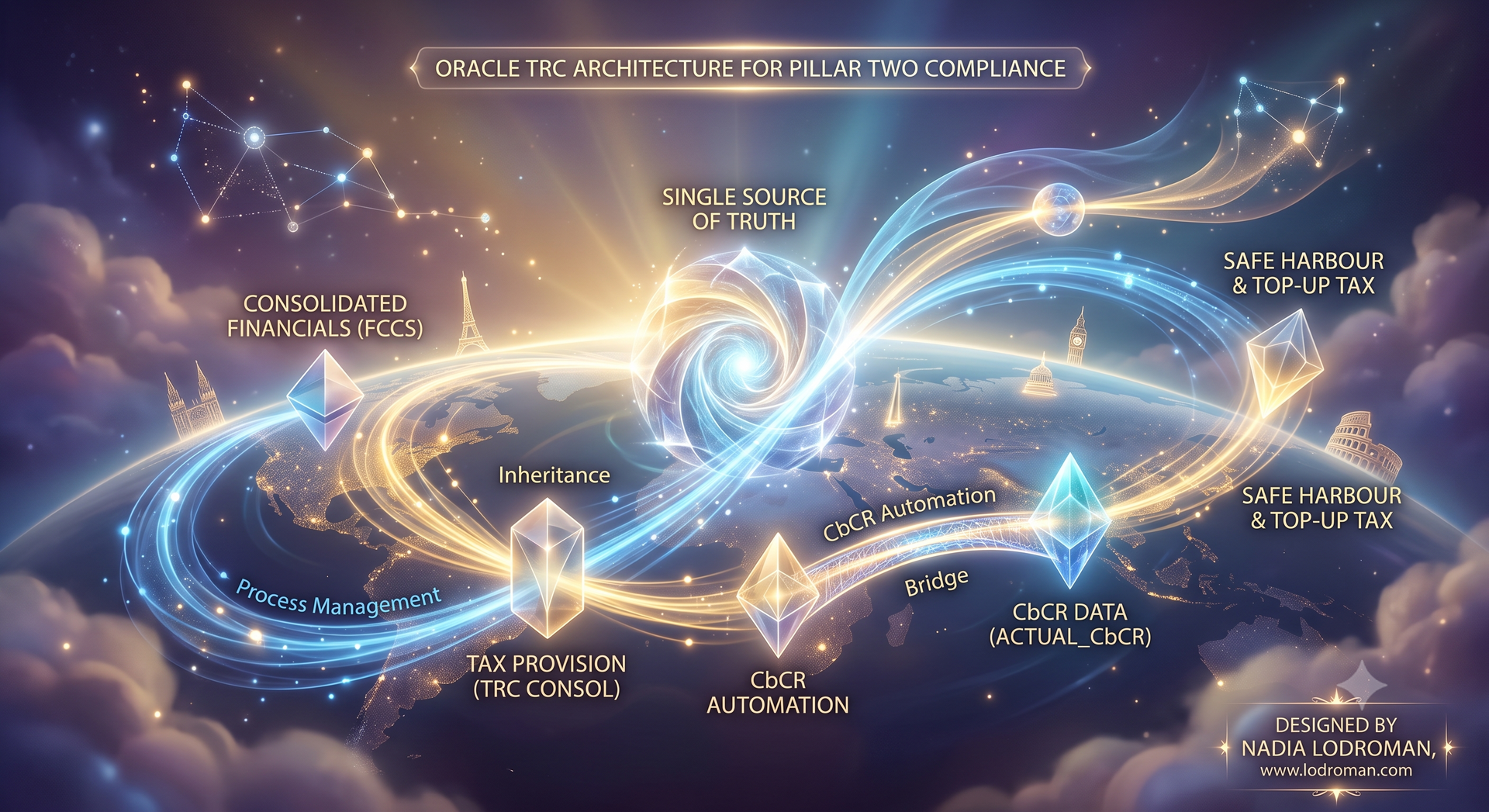
Does Oracle TRC handle Country-by-Country Reporting (CbCR)?
Yes. Oracle Tax Reporting Cloud (TRC) provides built-in frameworks to automate Country-by-Country Reporting, ensuring multinational organizations remain compliant with global BEPS (Base Erosion and Profit Shifting) regulations.
How does Oracle TRC integrate with FCCS?
TRC and FCCS share the same platform architecture, allowing for seamless data flow. Finalized pre-tax consolidated data from FCCS feeds directly into TRC for tax provisioning, ensuring perfect alignment between the finance and tax departments.
Still have a question?
All things Oracle EPM