An Oracle EPM Consultant’s Wishlist for 2026
Nadia Lodroman | Oracle EPM Consultant | Integrity in Every Insight.
Listen to Tresora and Ledgeron's chatting about this blog post:
Why 2026 is the year to stop "managing servers" and start driving Finance strategy with true Cloud-native EPM.
As we head into 2026, the gap between "modern finance" and "legacy survival" has never been wider. After years of watching teams struggle with broken links and server maintenance, here is the official 2026 wishlist—the things I hope every customer tells me this year.
1. "The hell with the Excel-hell—give us ARCS."
We’ve all seen the "Monster Workbook"—that 100MB spreadsheet that crashes if you breathe on it too hard. Whether you are on NetSuite, SAP, or Oracle ERP Cloud, manual reconciliations are a liability. In 2026, the novelty of Oracle ARCS for NetSuite is the standard. I want to hear: "We’re done ticking and tying by hand; let the system match the transactions so we can actually analyze the variances."
2. "We’re an SAP house, and we finally want a real EPM."
For decades, SAP customers have been the "silent majority" of the Oracle EPM world—making up nearly 50% of the user base. In 2026, I want to hear customers stop settling for "good enough" native ERP tools and embrace the best-in-class consolidation that only Oracle provides. It’s not about changing your ERP; it’s about upgrading your intelligence.
3. "Our tax provisioning shouldn’t be a panicked afterthought—let’s align it with our close."
In many organizations, the tax team is treated like the person invited to a party ten minutes before it ends—an afterthought expected to perform miracles. My wishlist includes a CFO saying, "Nadia, let's use TRCS to align tax reporting with corporate financial reporting". We’ll create seamless transparency between tax and finance, turning the "afterthought" into a strategic, automated compliant framework.
4. "No more 'Lift and Shift'—it’s time for Cloud-Native."
There is a massive difference between Cloud and Hosted. To the folks still running HFM on-premise or "hosting" it in a private cloud: you’re still paying for the infrastructure, the upgrades, and the headaches. My wish? Hearing: "Let's stop trying to keep this 15-year-old engine running on a new track. Let’s move to Oracle EPM Cloud and get monthly innovation, not just a monthly bill from a hosting provider."
5. "We’re done with the 'Hosted On-Prem' illusion."
Let's be honest about the OneStream model: putting legacy, monolithic architecture on AWS or Azure doesn't make it SaaS. It’s essentially a 30-year-old philosophy in a new data center. In 2026, I want to hear: "We’ve realized that 'hosted' still means we are responsible for the upgrade project. We want a true multi-tenant solution where Oracle manages the tech, and we manage the finance."
6. "Automate the Minority Interest and Intercompany—now."
If your team is still doing manual "Top-Side" adjustments for Intercompany eliminations or sweating over Minority Interest (NCI) calculations in a side-car spreadsheet, you aren't closing; you're just doing math. I want to hear: "We’re ready for Oracle FCCS to handle the complex equity eliminations out-of-the-box."
7. "Standardization over Customization."
The most expensive words in EPM are: "But our process is unique." In 2026, the dream is hearing: "Oracle built these modules based on global best practices. Let's fix our outdated processes to match the software, rather than coding ourselves into a corner we can't upgrade out of."
8. "Give us the AI-first pass."
By now, AI isn't a "future" feature—it’s a button in your ribbon. I want to hear: "I don't want my team building a baseline forecast from scratch. Let the AI Predictive Planning module do the first pass, and we’ll spend our time on the strategic exceptions."
Ready to cross these off your 2026 list?
Whether you are an SAP shop looking for a better close, a NetSuite customer ready for ARCS, or in need of a serious remediation project to move away from "hosted on-prem," let’s talk.
Visit me at www.lodroman.com or connect on Linkedin . Let’s stop talking about "Excel-hell" and start talking about your next "OK" status.
Turning financial complexity into operational clarity. Because in Finance, Integrity is Permanent.
General EPM Strategy FAQs
Why should a company use EPM Automate instead of custom scripting
EPM Automate allows for robust, bi-directional data orchestration between Oracle EPM and source ERPs (like NetSuite or Fusion) using native capabilities. It is highly scalable, easier to maintain during Oracle's monthly updates, and avoids the fragility of heavy custom coding.
Can Oracle Cloud EPM integrate with multiple different ERPs simultaneously?
Yes. Through strategic data pipeline architecture, Oracle EPM can ingest, consolidate, and even write-back finalized data to multiple disparate ERPs concurrently, acting as the single source of truth for the enterprise.
How does Oracle FCCS handle Minority Interest (NCI) and CTA?
While standard FCCS provides out-of-the-box functionality, complex global enterprises often require advanced configuration to isolate and calculate Minority Interest (NCI) and Cumulative Translation Adjustments (CTA) accurately at the top consolidated hierarchy without relying on manual journals.
Can you bypass the out-of-the-box Goodwill calculation in Oracle FCCS?
Yes. By utilizing advanced native configuration and custom consolidation rules, you can bypass standard Goodwill Input/Offset functionality to meet highly specific, non-standard acquisition accounting requirements.
How many daily transactions can Oracle ARCS process?
Oracle ARCS is built for enterprise scale. With proper architecture in the Transaction Matching engine, ARCS can easily process and auto-match hundreds of thousands of daily banking transactions, representing billions of dollars in value.
What is the difference between Transaction Matching and Reconciliation Compliance in ARCS?
Transaction Matching automates the high-volume, line-by-line matching of data (like daily bank feeds or ACH). Reconciliation Compliance is used to govern the period-end justification of broader balance sheet account balances.
Does Oracle TRC handle Country-by-Country Reporting (CbCR)?
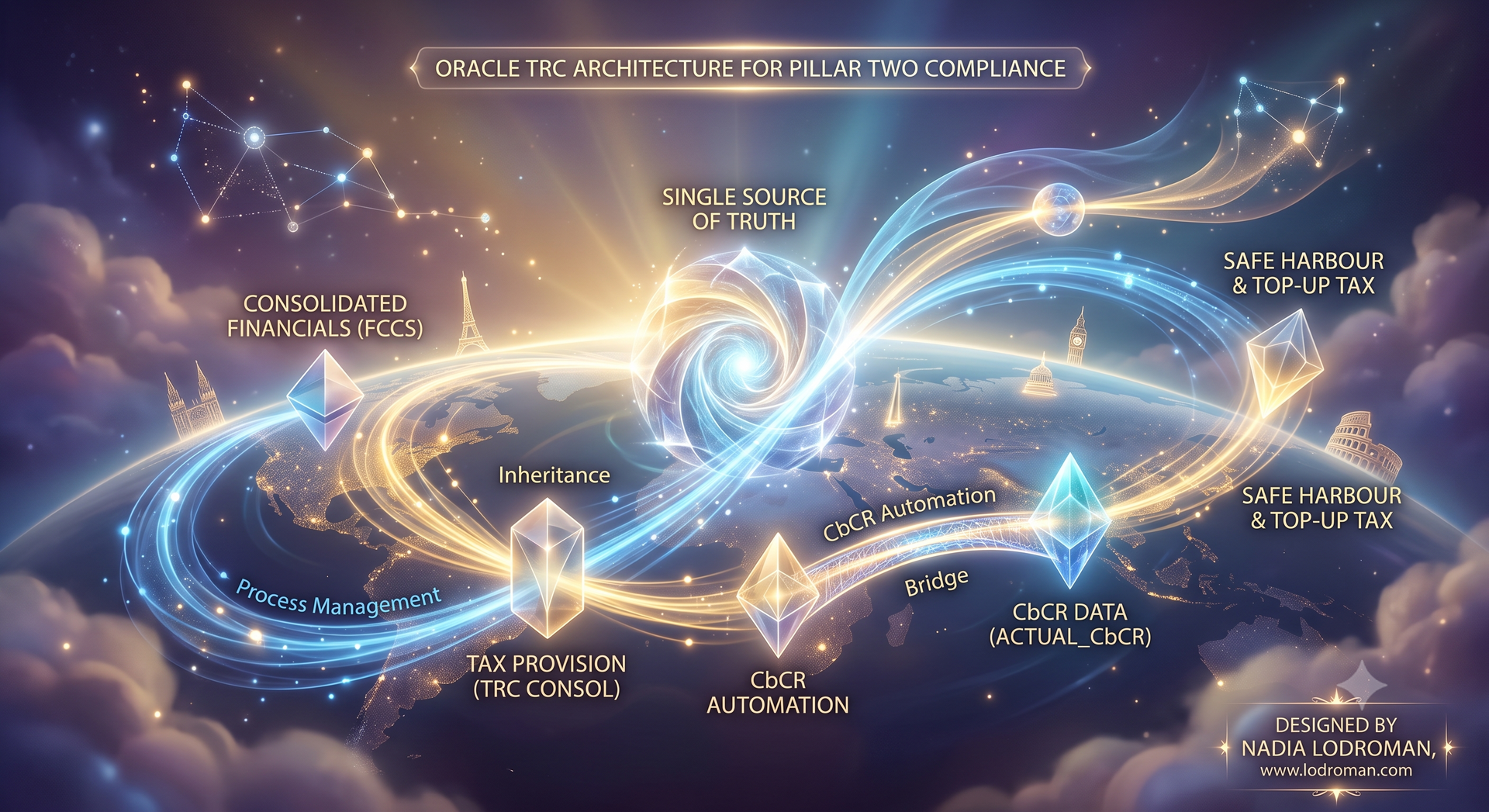
Yes. Oracle Tax Reporting Cloud (TRC) provides built-in frameworks to automate Country-by-Country Reporting, ensuring multinational organizations remain compliant with global BEPS (Base Erosion and Profit Shifting) regulations.
How does Oracle TRC integrate with FCCS?
TRC and FCCS share the same platform architecture, allowing for seamless data flow. Finalized pre-tax consolidated data from FCCS feeds directly into TRC for tax provisioning, ensuring perfect alignment between the finance and tax departments.
Still have a question?
All things Oracle EPM