Beyond the Spreadsheet
Nadia Lodroman | Oracle EPM Consultant | Integrity in Every Insight.
Listen to Tresora and Ledgeron's chatting about this blog post:
Three Ways Oracle TRC Pays for Itself in Year One
In the high-stakes world of corporate tax, the "Status Quo" is usually a labyrinth of interconnected Excel workbooks, fragile VLOOKUPs, and a "Master File" that only one person in the department truly understands. We tell ourselves that spreadsheets are free, but the reality is that they are one of the most expensive assets a company can own. They cost you in manual labor, they cost you in audit fees, and they cost you in the sleep you lose during the quarter-end close.
When talking with Tax Directors about migrating to Oracle Tax Reporting Cloud (TRC), the hesitation is rarely about the technology itself. It is almost always about the perceived mountain of implementation. However, the successful migrations aren't the ones that try to automate everything on day one. They are the ones that target the three specific "Value Pillars" where TRC pays for itself within the very first year of operation.
The End of the Roll-Forward Ritual
In a spreadsheet-based world, the "Opening Balance" is the first major hurdle of the year. Tax teams spend hundreds of hours manually pulling closing balances from last year’s audited workpapers and meticulously pasting them into new files. This is where the most dangerous errors are born. A single broken link or a mis-pasted column can leave your deferred tax assets fundamentally flawed before the first trial balance is even loaded.
Oracle TRC transforms this ritual into a non-event. Because the system is built on a unified dimensional backbone, the closing balance of the prior year automatically becomes the opening balance of the current year. There is no manual intervention required. By the time you start your first period close, your temporary differences and tax basis carryovers are already tied out. This doesn't just save time; it creates a bulletproof audit trail that satisfies even the most skeptical external auditors.
The Federal-to-State Automation Shortcut
For any organization with a significant US footprint, the state provision is typically a massive duplication of effort. Once the Federal provision is finalized, the team then has to do the work fifty more times, manually adjusting for state-specific decoupling and varying tax rates. It is a process ripe for human error and exhaustion-driven oversight.
This is where the National-to-Regional (N2R) automation within TRC becomes a force multiplier. By calculating the Federal provision once, the system can automatically "push" that taxable income down to every required state entity. TRC then applies the specific state-level modifications—like decoupling from bonus depreciation or unique state credits—instantly. You aren't just automating the math; you are automating the policy application. In year one, this feature alone can shave weeks off the state reporting cycle, allowing your team to focus on planning rather than data entry.
Global Visibility and the End of the "Black Hole"
Perhaps the greatest hidden cost of spreadsheets is the "Information Gap." During a global close, the head office often feels like it's shouting into a void, waiting for tax packages to arrive via email from remote subsidiaries. You never truly know if a region hasn't started, if they are struggling with a local GAAP adjustment, or if their data simply doesn't tie to the underlying Trial Balance until it's too late to react.
Oracle TRC replaces this uncertainty with a centralized Global Workflow Dashboard, supported by the native Task Manager functionality. Customers can have a "Central Command" view where every entity’s status is visible in real-time. If a subsidiary in EMEA is stuck on a validation error, you see it immediately. This shift moves the tax department from a reactive group chasing emails to a proactive team managing by exception. You stop being a "Data Gatherer" and start being a "Data Reviewer," which is exactly where the value of a tax professional truly lies.
The Consultant’s Perspective: Start Small, Win Big
The mistake most firms make is assuming that a TRC implementation has to be an "all or nothing" transformation that mirrors their most complex manual processes from day one. I have found that the most successful path to ROI is to start small and win big. You don't need to build every custom report or automate every fringe tax credit in the first ninety days. By focusing purely on the three pillars of automated roll-forwards, state-level logic, and global workflow, you establish a foundation that pays for itself in reduced man-hours and mitigated audit risk almost immediately.
Once those wins are secured and the "Closing Anxiety" has faded, we can then begin to layer on the advanced complexities. The goal isn't just to install software; it's to architect a transition that proves its worth to your CFO in the first twelve months. If you are ready to stop surviving your tax provision and start mastering it, let’s sit down and map out your first three wins. The spreadsheets got you to where you are today, but they won't take you to where you need to be tomorrow. Reach out to me
today to schedule a discovery session and let's turn your tax function into a streamlined, automated powerhouse.
Turning financial complexity into operational clarity. Because in Finance, Integrity is Permanent.
General EPM Strategy FAQs
Why should a company use EPM Automate instead of custom scripting
EPM Automate allows for robust, bi-directional data orchestration between Oracle EPM and source ERPs (like NetSuite or Fusion) using native capabilities. It is highly scalable, easier to maintain during Oracle's monthly updates, and avoids the fragility of heavy custom coding.
Can Oracle Cloud EPM integrate with multiple different ERPs simultaneously?
Yes. Through strategic data pipeline architecture, Oracle EPM can ingest, consolidate, and even write-back finalized data to multiple disparate ERPs concurrently, acting as the single source of truth for the enterprise.
How does Oracle FCCS handle Minority Interest (NCI) and CTA?
While standard FCCS provides out-of-the-box functionality, complex global enterprises often require advanced configuration to isolate and calculate Minority Interest (NCI) and Cumulative Translation Adjustments (CTA) accurately at the top consolidated hierarchy without relying on manual journals.
Can you bypass the out-of-the-box Goodwill calculation in Oracle FCCS?
Yes. By utilizing advanced native configuration and custom consolidation rules, you can bypass standard Goodwill Input/Offset functionality to meet highly specific, non-standard acquisition accounting requirements.
How many daily transactions can Oracle ARCS process?
Oracle ARCS is built for enterprise scale. With proper architecture in the Transaction Matching engine, ARCS can easily process and auto-match hundreds of thousands of daily banking transactions, representing billions of dollars in value.
What is the difference between Transaction Matching and Reconciliation Compliance in ARCS?
Transaction Matching automates the high-volume, line-by-line matching of data (like daily bank feeds or ACH). Reconciliation Compliance is used to govern the period-end justification of broader balance sheet account balances.
Does Oracle TRC handle Country-by-Country Reporting (CbCR)?
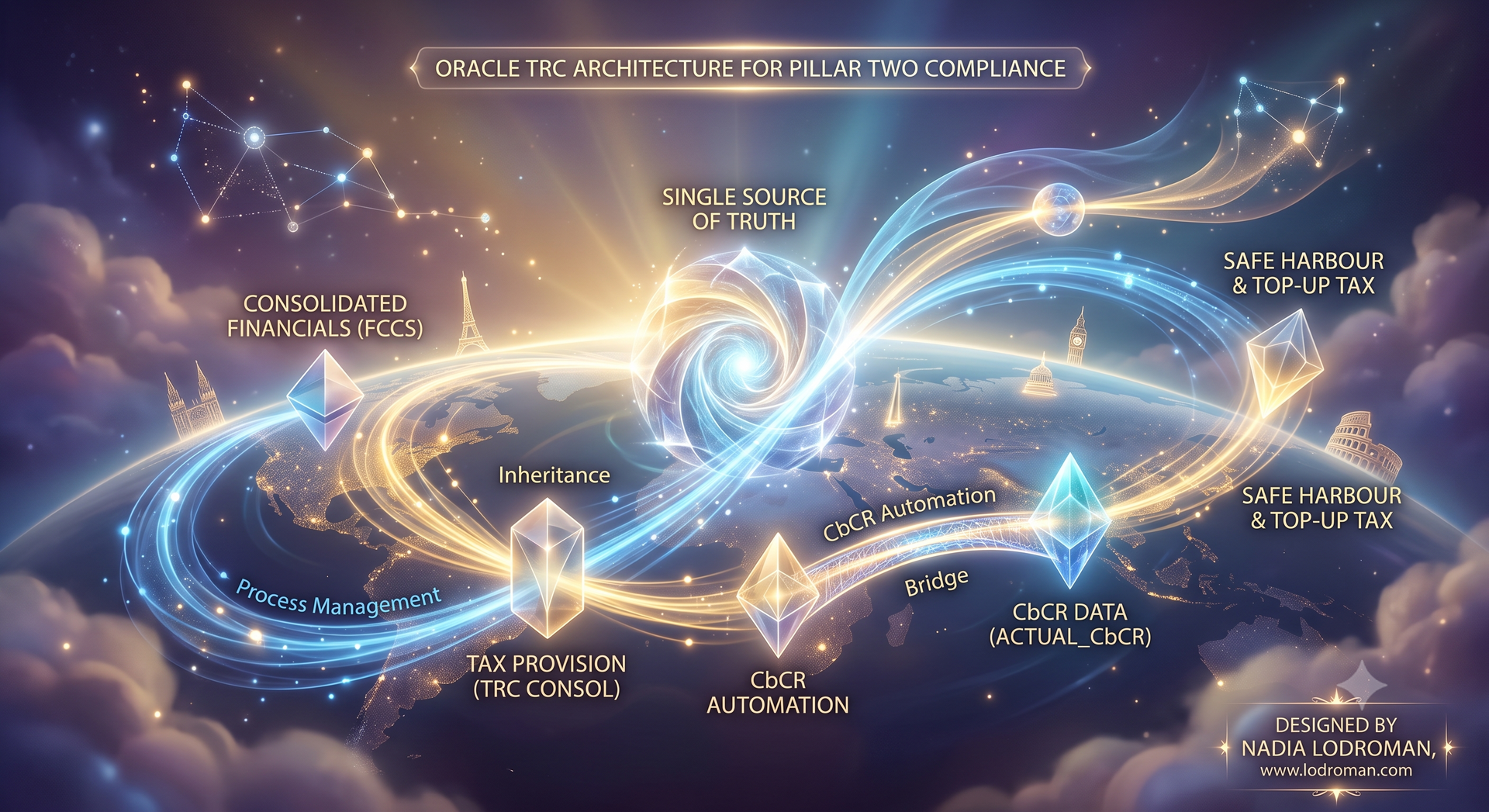
Yes. Oracle Tax Reporting Cloud (TRC) provides built-in frameworks to automate Country-by-Country Reporting, ensuring multinational organizations remain compliant with global BEPS (Base Erosion and Profit Shifting) regulations.
How does Oracle TRC integrate with FCCS?
TRC and FCCS share the same platform architecture, allowing for seamless data flow. Finalized pre-tax consolidated data from FCCS feeds directly into TRC for tax provisioning, ensuring perfect alignment between the finance and tax departments.
Still have a question?
All things Oracle EPM