Bypassing the Default Goodwill Reclass with Custom Consolidation Rules in Oracle FCCS
Nadia Lodroman | Oracle EPM Consultant | Integrity in Every Insight.
Listen to Tresora and Ledgeron's chatting about this blog post:
Beyond Out-of-the-Box
When implementing Oracle Financial Consolidation and Close (FCCS) for complex global enterprises, the standard, out-of-the-box consolidation rules are fantastic for getting a project off the ground quickly. However, any seasoned EPM architect knows that "standard" rarely covers 100% of a multinational’s accounting reality.
One of the most common hurdles I encounter involves the automated elimination of Investments in Subsidiaries. By default, FCCS handles this by eliminating the investment and pushing the offset to a seeded Goodwill account. But what happens when your applicable accounting standards or specific corporate structures dictate that this offset shouldn't go to Goodwill at all, but rather to a bespoke account like Paid-in Capital?
In this post, I will walk you through how to bypass the default Goodwill reclass and build a Custom Consolidation Rule to handle bespoke investment offsets natively within FCCS.
The Problem: When Standard Goodwill Logic Doesn't Fit
Out-of-the-box, FCCS uses seeded rules (specifically the Investment rule within the Consolidation Process) to credit the Investment in Sub account and debit Goodwill (or a Goodwill Offset account).
While this aligns with standard acquisition accounting, it can cause severe headaches for organizations that have alternative statutory requirements, specific joint-venture structures, or historical intercompany investments that require the offset to hit an equity account, like Paid-in Capital.
If you try to "fix" this with manual journal entries every month, you are defeating the purpose of an automated consolidation engine. We need the system to do this automatically.
The Solution: Configurable Consolidation Rules (CCR)
The beauty of modern FCCS is that we don't need to write complex custom scripts to solve this. We can use the native Configurable Consolidation framework to disable the seeded logic and introduce our own.
Here is the architectural approach to building this bespoke reclass:
Step 1: Disable the Seeded Investment Rule
Before we build the new logic, we must tell FCCS to stop executing the default Goodwill offset.
- Navigate to Consolidation -> Configurable Consolidation.
- Locate the seeded rule set for Investment Elimination.
- You can selectively disable the specific rule pushing the offset to Goodwill for the specific scenarios or entities where it doesn't apply.
Step 2: Define the Custom Data Set
Next, we create a new rule within the Configurable Consolidation screen.
- Source: Define the data intersection you want the rule to pick up. In this case, it will be your Intercompany Investment in Sub accounts, filtered by the specific Movement and Intercompany dimension members.
- Condition: Apply any necessary conditions to ensure this rule only fires for the specific subsidiaries or consolidation nodes where the Paid-in Capital treatment is permitted by local GAAP.
Step 3: Map to the Bespoke Destination (Paid-in Capital)
Here is where the magic happens. In the Destination mapping of your new rule:
- Map the elimination (the reversal of the investment) as normal to clear the intercompany balance.
- For the offset, instead of selecting the default FCCS_Goodwill Offset, map it directly to your target equity account: Paid-in Capital.
Why This Architecture Matters
By utilizing Configurable Consolidation Rules instead of manual topside journals, you achieve three critical things:
- Auditability: The elimination and bespoke reclass are fully traceable within the system's consolidation execution logs.
- Scalability: As the company acquires or spins off more subsidiaries, the rule automatically applies based on your entity metadata tags. No new journals are needed.
- Performance: Native rules process highly efficiently during the consolidation script execution, keeping your close cycle fast.
As EPM architects, our goal isn't just to make the system work; it's to make the system reflect the true accounting reality of the business without adding manual maintenance overhead.
I am an Oracle EPM Consultant specializing in FCCS, TRC, and ARCS, helping global enterprises architect automated, audit-ready financial close processes.
Turning financial complexity into operational clarity. Because in Finance, Integrity is Permanent.
General EPM Strategy FAQs
Why should a company use EPM Automate instead of custom scripting
EPM Automate allows for robust, bi-directional data orchestration between Oracle EPM and source ERPs (like NetSuite or Fusion) using native capabilities. It is highly scalable, easier to maintain during Oracle's monthly updates, and avoids the fragility of heavy custom coding.
Can Oracle Cloud EPM integrate with multiple different ERPs simultaneously?
Yes. Through strategic data pipeline architecture, Oracle EPM can ingest, consolidate, and even write-back finalized data to multiple disparate ERPs concurrently, acting as the single source of truth for the enterprise.
How does Oracle FCCS handle Minority Interest (NCI) and CTA?
While standard FCCS provides out-of-the-box functionality, complex global enterprises often require advanced configuration to isolate and calculate Minority Interest (NCI) and Cumulative Translation Adjustments (CTA) accurately at the top consolidated hierarchy without relying on manual journals.
Can you bypass the out-of-the-box Goodwill calculation in Oracle FCCS?
Yes. By utilizing advanced native configuration and custom consolidation rules, you can bypass standard Goodwill Input/Offset functionality to meet highly specific, non-standard acquisition accounting requirements.
How many daily transactions can Oracle ARCS process?
Oracle ARCS is built for enterprise scale. With proper architecture in the Transaction Matching engine, ARCS can easily process and auto-match hundreds of thousands of daily banking transactions, representing billions of dollars in value.
What is the difference between Transaction Matching and Reconciliation Compliance in ARCS?
Transaction Matching automates the high-volume, line-by-line matching of data (like daily bank feeds or ACH). Reconciliation Compliance is used to govern the period-end justification of broader balance sheet account balances.
Does Oracle TRC handle Country-by-Country Reporting (CbCR)?
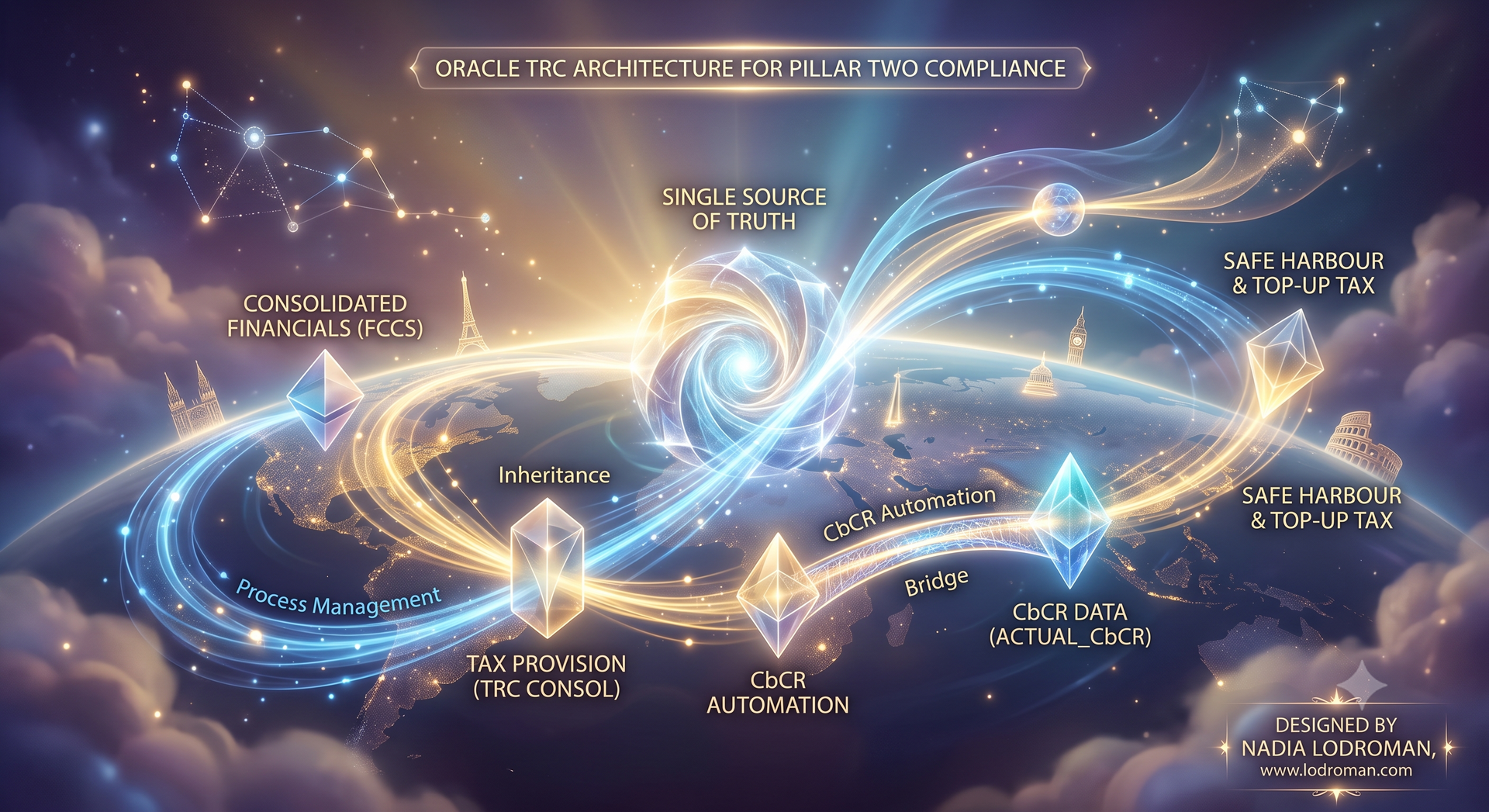
Yes. Oracle Tax Reporting Cloud (TRC) provides built-in frameworks to automate Country-by-Country Reporting, ensuring multinational organizations remain compliant with global BEPS (Base Erosion and Profit Shifting) regulations.
How does Oracle TRC integrate with FCCS?
TRC and FCCS share the same platform architecture, allowing for seamless data flow. Finalized pre-tax consolidated data from FCCS feeds directly into TRC for tax provisioning, ensuring perfect alignment between the finance and tax departments.
Still have a question?
All things Oracle EPM